
Explainers
IQ vs EQ: what the comparison hides
EQ became popular by promising what IQ could not deliver. The measurement evidence is considerably thinner than the popularity suggests.
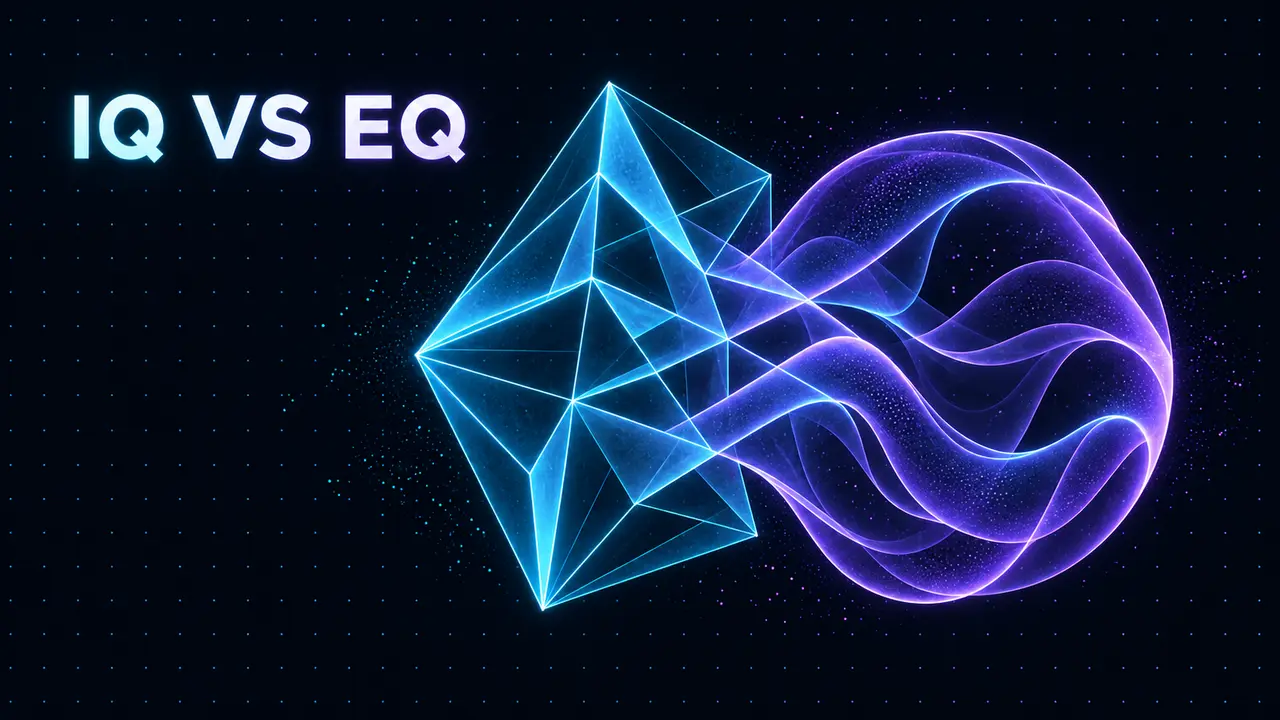
The claim that made EQ famous
Emotional intelligence entered public consciousness in 1995 with Daniel Goleman's book, and the framing that travelled was specific and appealing: EQ matters more than IQ for success in life.
It was a good story with an obvious audience. It also went considerably further than the research supported at the time, and further than the research supports now.
Two different things are called EQ
The literature contains two distinct research programmes that share a name and do not share much else. Not distinguishing them is the source of most of the confusion.
Ability EQ treats emotional understanding as a cognitive skill with right and wrong answers. The MSCEIT is the standard instrument, and items ask things like which emotion a face is expressing or which response would best regulate a described feeling. Scores correlate modestly with IQ, around 0.3, which is what you would expect if it is a narrow ability within the cognitive family.
Trait EQ is a self-report questionnaire asking how good you think you are at reading and managing emotions. It correlates strongly with established personality measures — particularly extraversion, agreeableness and low neuroticism — and weakly with actual ability EQ.
The popular literature usually cites the outcome studies from trait measures while describing them in the language of ability. That move is what makes the claims sound stronger than they are.
Trait EQ questionnaires ask you to rate your own emotional skill. People who rate themselves highly on anything tend to rate themselves highly on everything, and self-rated emotional skill correlates weakly with measured emotional skill.
What EQ predicts once you control for the obvious
The right question is not whether EQ correlates with outcomes — it does — but whether it adds anything once personality and cognitive ability are accounted for.
Meta-analyses that run that test find a small amount of incremental validity for job performance, larger in roles with heavy emotional demands such as sales, nursing and customer-facing work, and near zero in roles without them. The increment is real and modest.
The headline claim — that EQ outweighs IQ for career success — does not survive this analysis. Cognitive ability remains the stronger predictor for complex work. Where EQ contributes, it contributes on top rather than instead.
Why “versus” is the wrong preposition
The two are not competing measures of the same thing, and framing them as rivals makes both harder to understand.
IQ tests sample reasoning with novel material. Emotional intelligence measures sample either a narrow ability within the same cognitive family or a cluster of personality traits. They predict overlapping outcomes through different routes and they are weakly correlated, which means knowing one tells you little about the other.
The genuine insight buried in the popular version is worth keeping: cognitive ability is not sufficient for most things people want, interpersonal skill matters enormously in most work, and a test of reasoning does not measure it. All of that is true and none of it requires the claim that EQ beats IQ.
Can you improve it?
This is where EQ has a genuine advantage over IQ, and it is not the advantage usually advertised.
Emotional skills respond to training more readily than reasoning ability does. Specific, trainable components — recognising your own state before acting, reading a room, regulating a response under pressure, giving difficult feedback — improve with deliberate practice and feedback in a way that fluid reasoning does not.
The catch is that the improvement is specific. Training in recognising facial affect improves facial affect recognition. It does not produce a general emotional competence that transfers everywhere, and the transfer problem is the same one that sank brain-training.
The practical version
Cognitive ability predicts a meaningful slice of performance on complex work, and there is not much you can do to change yours as an adult.
Emotional and interpersonal skill predicts a smaller slice overall, a larger one in emotionally demanding roles, and it is substantially more trainable.
That combination is the useful conclusion, and it happens to be the opposite of how the comparison is usually sold. EQ is worth attention not because it outranks IQ but because it is the one of the two you can actually work on.
Questions
Questions people ask
Is EQ more important than IQ?
Not in general. Cognitive ability remains the stronger predictor of performance in complex work. Emotional intelligence adds a small increment, larger in emotionally demanding roles, once personality and ability are controlled for.
Can you measure emotional intelligence?
Two ways, which do not agree well. Ability tests such as the MSCEIT score right and wrong answers; self-report questionnaires measure how emotionally skilled people believe they are, and correlate strongly with personality.
Can emotional intelligence be improved?
Specific components respond to deliberate practice and feedback more readily than reasoning ability does. Gains tend to be specific to what was trained rather than general.
Do IQ and EQ correlate?
Ability-based emotional intelligence correlates with IQ at around 0.3. Self-report emotional intelligence correlates weakly with IQ and strongly with personality traits.
Keep reading
 Evidence
How to increase your IQ: what the evidence supports and what it does not
Brain-training apps, dual n-back, supplements, music, sleep. Sorting the interventions with evidence behind them from the ones with marketing behind them.
11 min read Methods
How accurate is an IQ test, really?
Reliability, validity and the standard error of measurement, explained without the jargon and with the numbers that actually apply.
10 min read Research
The Flynn effect: why IQ scores rose for a century, and why they may be falling
Raw scores climbed roughly three points a decade for most of the twentieth century. Nobody fully agrees why, and in several countries the climb has stopped.
9 min readFind out where you land
Ten reasoning questions, an instant band and an explanation for every answer.